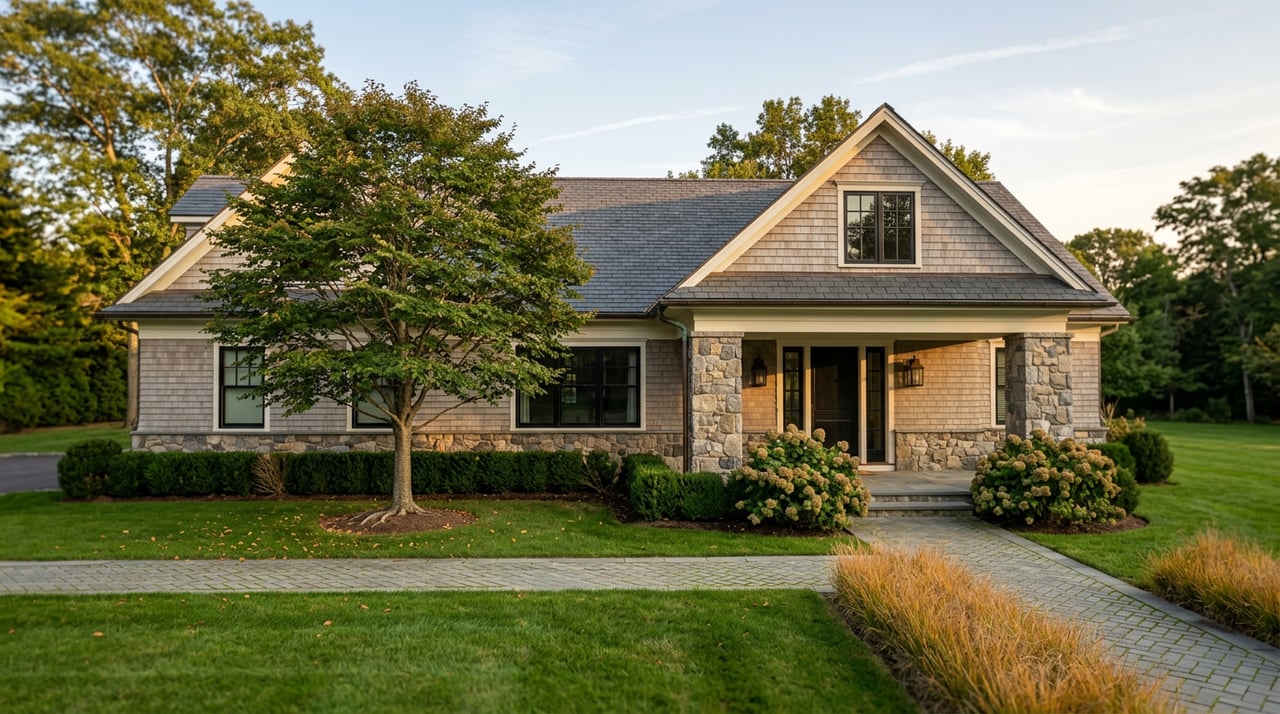
A buyer comparing a $2.5 million listing in Rowayton to a $2.5 million listing in Darien is not comparing two versions of the same product. The listings might look identical on paper. The house on the Five Mile River side has a name that reads like Darien or New Canaan. The tax bill that arrives after closing does not.
That surprise rarely shows up on a portal estimate. It shows up later, usually when a buyer's attorney or lender pulls the actual mill rate and the number is meaningfully higher than the one quoted for the town next door. By the time most buyers learn why, they are already past the point where it would have changed their offer strategy.
Where the Second Tax Bill Comes From
The Sixth Taxing District's official history explains that Rowayton is not its own town. Legally, it is the Sixth Taxing District of the City of Norwalk, a status that dates back to 1921, when a merger folded several formerly separate communities into one municipality. South Norwalk became the Second Taxing District. Norwalk proper became the First. East Norwalk became the Third. Rowayton became the Sixth. The city government layered a citywide tax on top of all of them, but four of the original districts kept the right to also tax themselves separately for the specific local services the city didn't take over.
Rowayton still uses that right. It is governed day to day not by Norwalk's mayor or Common Council, but by three elected District Commissioners, currently Alex Sparkman, Jody Sattler, and Andy Meyerson, who run an annual town meeting every March to approve the district's own roughly $2 million budget. According to the district's own explanation of how the money flows, when a Rowayton homeowner pays property taxes, about 5 percent of that payment funds the district itself, while the remaining 95 percent goes to the City of Norwalk's general fund for schools, police, and citywide infrastructure.
That 5 percent is not decorative. It funds the Rowayton Library, the Rowayton Fire Department, Pinkney Park, Bayley Beach, the Rowayton Community Center, the Rowayton Arts Center, garbage and leaf pickup, street lighting, and the parking lot at the Rowayton train station. Everything else on your bill, including the schools and the police department that also serve Rowayton, is paid for at Norwalk's citywide rate, the same rate a home in West Norwalk or East Norwalk pays.
The Rate Gap Is the Real Story, Not the Village Fee
Here is the part that surprises buyers who assume the extra cost of a Rowayton address is a premium for village charm. It mostly isn't. The bulk of the gap between what a Rowayton buyer pays and what a Darien or New Canaan buyer pays for a comparably priced house has nothing to do with Rowayton at all. It's driven by the fact that Norwalk's citywide mill rate is higher than Darien's or New Canaan's, for reasons that apply to the entire city, not to the village.
As of the most recently set rates, Norwalk's Sixth Taxing District carries a combined real estate mill rate of 22.3924 for the 2025-26 fiscal year, and Norwalk's Board of Estimate and Taxation approved roughly 3 percent increases across all six taxing districts for the fiscal year that began July 1, 2026, so the current figure is somewhat higher than that baseline. Darien's Representative Town Meeting approved a 16.05 mill rate for the 2026-27 fiscal year. New Canaan's Board of Finance set its rate at 16.691 for fiscal year 2026, the most recent figure confirmed at the time of writing.
This illustration uses the rates listed above, including Rowayton's 2025-26 baseline; it is not a same-fiscal-year comparison. On a $2.5 million purchase, applying the standard 70 percent assessment ratio under Connecticut General Statutes § 12-62a(b) to the same hypothetical price across all three towns, the figures are:
| Town | Mill rate | Assessed value (70%) | Estimated annual tax |
|---|---|---|---|
| Rowayton (Norwalk 6th District) | 22.3924 | $1,750,000 | ~$39,187 |
| Darien | 16.05 | $1,750,000 | ~$28,088 |
| New Canaan | 16.691 | $1,750,000 | ~$29,209 |
Using the rates in this illustration, the gap between Rowayton and Darien on an identical purchase price is around $11,000 a year, or roughly 39 percent higher. Of that illustrative Rowayton bill, only about $1,959, the 5 percent share, funds anything specific to the village. The other $37,228 is simply Norwalk's citywide rate applied to a Rowayton address. A buyer who assumes the extra cost buys extra village service is only right about a small fraction of it. Most of it is a function of which municipal budget the address happens to fall under.
Actual assessed values will vary by property and by each town's revaluation cycle, so treat this table as illustrative rather than a substitute for pulling the specific parcel's current assessment before writing an offer.
Why South Norwalk and East Norwalk Don't Have This Same Line Item
If Rowayton's arrangement sounds unusual, it's worth knowing that three of Norwalk's other historic districts, the First, Second, and Third, don't charge their residents a separate visible district tax at all, even though they technically could. The reason is that those districts each historically owned a utility company, the First District Water Department and South Norwalk Electric and Water among them, and use utility revenue to cover their extra costs instead of a tax line. Rowayton never owned a utility company, so it has no equivalent revenue source. The village funds its fire department, library, and beaches the only way it can, through a direct assessment on its own residents.
That history explains why a Rowayton listing carries a governance layer that a similarly priced South Norwalk or East Norwalk listing does not, even though all four are technically the same city.
Is Rowayton Actually More Expensive Than Darien?
The honest answer is that the sale prices alone won't tell you. Rowayton's median sale price has moved across a wide range in 2026 depending on the month and which handful of homes closed, and Darien's median has shown similar swings over the same period. Both are small, low-volume luxury markets where a single high-end closing or a cluster of smaller sales can move the median significantly from one reporting period to the next. Treating either number as a fixed price point is a mistake regardless of which town you're comparing.
What doesn't move around from month to month is the mill rate differential. Darien's and New Canaan's rates are set once a year through their town budget processes and don't fluctuate with which house happens to sell. That stability is exactly why the tax structure, not the median price, is the more reliable number to compare when you're deciding between towns that increasingly land in the same price band.
What This Means If You're Comparing Offers
If you're weighing a Rowayton property against something in Darien or New Canaan at a similar price point, the smarter question isn't "which town is more expensive to buy into." At current price levels, that answer changes by the month. The better question is what the total holding cost looks like once you add the property tax line to your monthly budget, since that's the number that stays fixed for years and compounds over the life of ownership.
That means asking your agent or attorney to pull the specific parcel's current assessed value and combined mill rate before you write an offer, not after. It means understanding that Rowayton's village institutions, the library, the fire department, Bayley Beach, are real and locally governed, but they're a small slice of what separates the two tax bills. And it means recognizing that a Rowayton address gives you Norwalk's citywide services and Norwalk's citywide rate, with a small, specific, and genuinely local add-on layered on top.
A Few Questions Worth Asking Directly
Does a portal estimate show this two-part tax structure? Most home value estimators show a single blended annual tax figure without separating the citywide portion from the district assessment. You won't see the split until you pull the actual bill or ask the town assessor directly.
Will my mortgage escrow account handle both pieces automatically? Yes. Your lender's escrow account pays the combined tax bill as one payment to Norwalk, which then routes the district's share internally. You don't need to manage two separate payments.
Does this affect resale value? Not directly. Buyers who understand the structure tend to weigh it as a cost-of-ownership factor rather than a red flag, the same way they'd weigh any town's tax rate. What matters most for resale is pricing the home correctly against true comparables, not against a citywide median that may not reflect the district you're actually in.
If you're weighing a move between Rowayton, Darien, New Canaan, or any of the towns along this stretch of the Gold Coast, the numbers behind the listing matter as much as the listing itself. Rachel Walsh has spent her career in these specific towns and can walk you through what a given address actually costs to hold, not just what it costs to buy. Book an appointment to talk through the comparison before you write your next offer.
This article is general information, not legal, tax or financial advice. Consult a qualified professional about your situation.