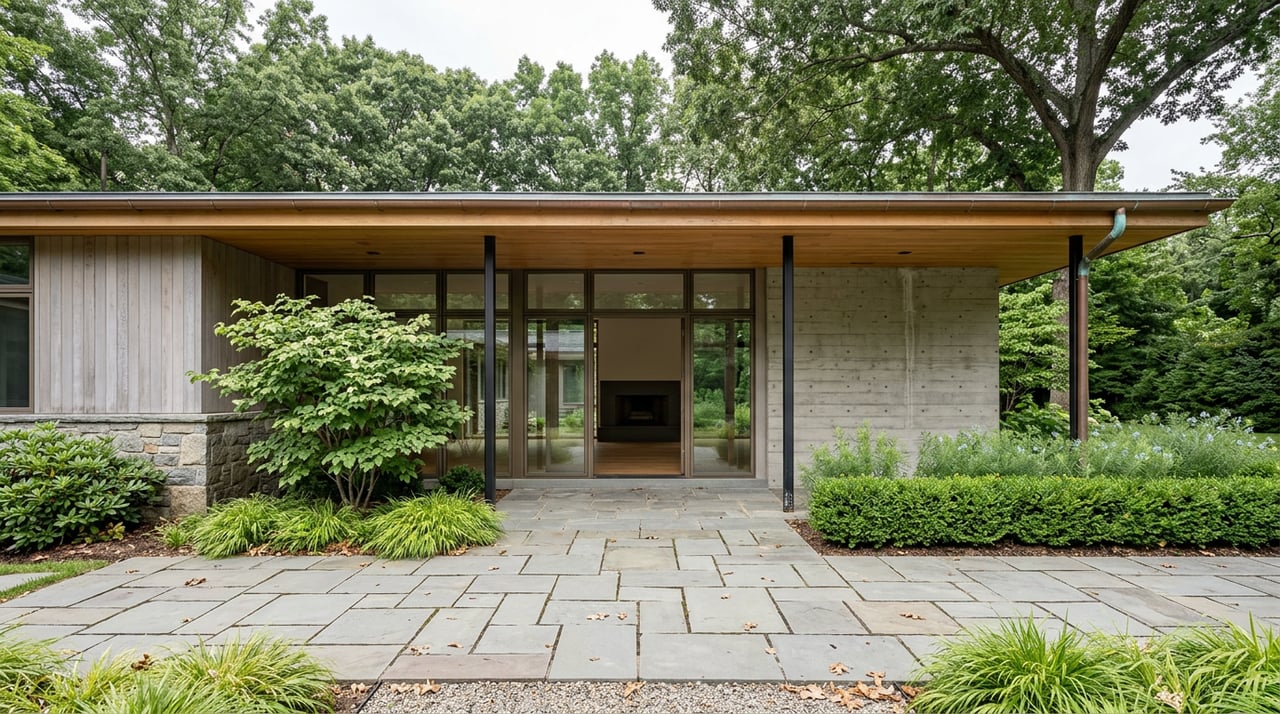
Ask a buyer why they want a Harvard Five house, and the answer usually starts with a name: Johnson, Breuer, Noyes. Ask an appraiser why that same house gives them pause, and the answer is different. There is nothing close enough nearby to compare it to.
That gap between what a name promises and what a bank will actually lend against is the real story in New Canaan's midcentury modern market. It shows up long before closing, in the appraisal, and it explains why two equally famous houses can sell for wildly different premiums over what the town says they're worth.
The Appraisal Problem Nobody Mentions Until It's Too Late
A standard appraisal leans on recent sales of similar homes nearby, matched for size, age, and condition. That system works well for a center-hall Colonial on a quarter acre with three others just like it on the same street. It works badly for a 1959 house with a pyramidal glass roof, or a Frank Lloyd Wright design on a double-digit wooded acreage, because there is no street of three others just like it.
This is not a hypothetical problem for New Canaan. The town's Modern Homes Survey, sponsored by the New Canaan Museum and Historical Society, documented 91 architect-designed modern houses in town. Only 17 of those were built by the five architects most people mean when they say "Harvard Five." The rest were designed by dozens of other architects working in the same period, in the same idiom, on the same kind of land. A house can be genuinely midcentury modern, genuinely well built, and still have almost nothing in the assessor's database it can be measured against.
For a buyer financing the purchase, that scarcity of comparables is a real friction point. It can slow an appraisal, invite a lower valuation than the contract price, or push a lender to ask for extra documentation before they'll sign off. For a seller, it means the asking price has to be defensible on grounds beyond "recent sales nearby," because there often aren't enough of those to make the case on their own.
What Thirty-Six Sales Actually Show
A local brokerage analysis looked at recent New Canaan sales and isolated 36 that involved architect-designed midcentury modern homes, comparing each sale price to the town's tax assessment for that property. The pattern that emerged was not a flat premium. It ranged from a few hundred thousand dollars to several million, and the size of that range is the point. A famous name does not set a price floor. It sets a range, and where a specific house lands in that range depends on what else it has going for it.
Three sales make the range concrete.
| Property | Architect / Year | Result vs. tax assessment |
|---|---|---|
| Tatum House | Hugh Smallen, 1962 | Sold for more than $2 million above assessment |
| Wiley House | Philip Johnson, 1952 | Sold for a $1.4 million premium |
| Tirranna | Frank Lloyd Wright, 1955 | Sold for $4.8 million in 2018, no premium at all |
Tirranna is the sale that should reframe how a buyer reads architectural pedigree. It carries arguably the most recognizable name in American architecture, and it still sold with no premium over its assessed value. The explanation the brokerage's own analysis offered was straightforward: the house sits on 15 acres, and acreage of that scale changes how a buyer values the property regardless of who designed the house on it. A famous signature does not override the math of the land underneath it.
Compare that to Tatum House, designed by Hugh Smallen in 1962 and expanded by the same architect in 1967. It sits on two acres in the Silvermine section of town, a smaller and more typical New Canaan lot, and it still carried a premium north of $2 million. The land was ordinary. The premium came from somewhere else, most likely the condition of the design itself and how faithfully it had been kept.
That is the mechanism worth carrying into any comparison of modern homes: the premium tracks the house and the site together, not the architect's name in isolation.
Two Recent Listings, Two Different Signals
Two examples from the past year show this playing out in close to real time rather than in a retrospective sales analysis.
The Celanese House, at 565 Oenoke Ridge, was designed in 1959 by Edward Durrell Stone, an architect whose other work includes Radio City Music Hall and the Kennedy Center. It was commissioned by the Celanese Corporation of America specifically to showcase the company's building materials, and it is known for glass pyramid skylights and a decorative screened front. As of December 2025 it was priced at $4.7 million. By April 2026 the price had moved to $4.4 million, a $300,000 reduction on a property with genuine architectural credentials. That kind of adjustment on a named house tells a buyer something useful: even a documented, historically significant design has to clear the market at a price the market will actually pay, not the price its story alone might justify.
The Evans House, at 44 Benedict Hill Road, offers a different kind of signal. Designed in 1961 by James Evans, a student of Louis Kahn, the house is known for a hyperbolic paraboloid roof that opens the main level to floor-to-ceiling glass. As of September 2025 it was listed at $2.75 million, a more modest number that reflects a smaller, less land-heavy property with a design pedigree that is real but less institutionally documented than Stone's. Two houses, two architects with real credentials, two very different price points, both defensible once you look past the label and toward the specifics of size, land, and how well the design has held up.
The Five Are Not the Ninety-One
It is worth returning to that Modern Homes Survey number, because it changes how a buyer should shop. If someone tells you a house is midcentury modern in New Canaan, that description covers 91 documented properties built across several decades by dozens of architects. Only a small fraction of those carry the Harvard Five credential specifically. The rest are still legitimate examples of the movement, sometimes beautifully executed, but they do not automatically carry the same appraisal or resale story as a documented Johnson or Breuer.
This distinction matters most at the point of financing. A listing description that says "midcentury modern" is not the same claim as "designed by a member of the Harvard Five," and the two can result in very different conversations with a lender's appraiser. Buyers who care about this distinction, and there is a real community of them in town, tend to know the difference already. The Grainger Society, a private group of midcentury modern enthusiasts, organizes tours through some of the town's most significant examples, including the Celanese House, and that kind of local, informed audience is exactly the buyer pool a well-documented modern home is competing for.
What This Means If You're Comparing
If you are weighing a modern home against a Colonial in New Canaan, the design premium question is not whether the architect's name is famous enough. It is whether the specific combination of land, condition, and documented authorship supports the number being asked. A smaller lot with a faithfully preserved design by a lesser-known but real midcentury architect can outperform a famous name sitting on land the market doesn't reward as heavily. The name opens the conversation. The land, the condition, and the paper trail close it.
For sellers, that means building the case for a modern home's value with more than the architect's biography. Documentation of authenticity, a clear renovation history, and comparable sales pulled from a wider radius than a typical Colonial appraisal would use all matter more here than they would on a standard listing. For buyers, it means asking early whether a house's design pedigree is documented well enough to survive a lender's scrutiny, not just well enough to make a good story at an open house.
A Few Questions Worth Asking Directly
Does a house need to be one of the original Harvard Five designs to carry a premium? No. The sales data shows premiums attached to architects working in the same period and idiom who were not part of that original group. What tends to matter more is documented authenticity and how intact the design has remained.
Why does a scarcity of comparables slow down financing? Lenders rely on an appraisal grounded in recent, similar sales. When a house has few true peers within a reasonable distance and timeframe, the appraiser has to work harder to build a defensible valuation, and that can add time or additional documentation requests before closing.
If you are comparing a modern home against a more traditional property in New Canaan, or trying to figure out what a specific piece of architectural history is actually worth against today's market, that is exactly the kind of conversation worth having before you write an offer, not after. Rachel Walsh has spent years walking through New Canaan's houses at every stage, from inspection to closing, and can help you separate what a name promises from what the numbers will actually support. Book an appointment to talk through your specific situation.
This article is general information, not legal, tax or financial advice. Consult a qualified professional about your situation.